Towing an AWD Car in DeLand: Why the Drivetrain Picks the Truck
An all-wheel-drive car is one connected system from the front hubs to the rear axle. Roll two of its wheels down a highway while the other two ride on a truck, and every shaft and coupling in between keeps turning with nothing driving it. That is why owner's manuals barely hedge on this question. They answer it inside a warning box, and they answer it the same way across brands that agree on almost nothing else. Drivers around DeLand hit it in angled parking downtown, on the shoulder of New York Avenue, and on soft ground out toward the river. Here is what an AWD drivetrain actually requires, and why that requirement decides which truck gets sent.
Key Takeaways
- Mazda's instruction for AWD vehicles is unqualified: always tow an AWD vehicle with all four wheels off the ground.
- Hyundai allows two ways to meet that standard, a wheel lift paired with dollies or a flatbed, as long as no wheel is left rolling.
- Kia states that a 4WD vehicle should never be towed with the wheels on the ground, and warns of serious damage to the vehicle or the 4WD system.
- Shifting to neutral protects the transmission but does not disconnect an all-wheel-drive system, so it is not a substitute for lifting every wheel.
- Sling-type equipment is ruled out by Hyundai and Toyota alike, whatever the drivetrain, because of the body damage it causes.
- Toyota warns that a vehicle loaded with its tires still touching the ground may fly off the truck, which is why tire strapping belts are specified.
Every AWD Manual Lands on the Same Instruction
An all-wheel-drive vehicle should be moved with all four wheels off the ground, and manufacturers state that as an instruction rather than a preference. Mazda is about as plain as a manual gets: the 2026 CX-50 owner's manual says to always tow an AWD vehicle with all four wheels off the ground, and adds that towing one with either the front or rear wheels on the ground is dangerous because the drive train could be damaged. Kia arrives at the same place from the four-wheel-drive side, telling owners a 4WD vehicle should never be towed with the wheels on the ground and that doing so can cause serious damage to the vehicle or the 4WD system. Two companies, two drivetrain philosophies, one shared answer. What varies between brands is the method and the tie-down detail. Notice what the language is doing, too: these are not maintenance notes about wear, they are warnings, sitting next to the instructions for a car that will not move under its own power.
What Keeps Turning When Two Wheels Stay Down
Anything mechanically attached to a rolling wheel rolls with it, and in an all-wheel-drive car that chain runs a long way. The wheel turns an axle shaft, the shaft turns a differential, the differential turns a driveshaft, and the driveshaft runs fore or aft into the centre coupling or transfer case that ties the two axles together. During a tow the engine is off, so nothing in that chain is being driven the normal way. The road is driving it, backwards, through parts built to be turned from the other end. An all-wheel-drive system has no free-wheeling position a driver can select, which is the whole point of it: the axles are deliberately linked so traction is never left to one end alone. The manuals do not publish a failure mechanism, and it would be guesswork to invent one. They do name what they are protecting. Mazda names the drive train; Kia names the 4WD system. Both are components that exist only on a car sending power to all four corners.
Wheel Lift, Dollies and Flatbed: What Each One Actually Does
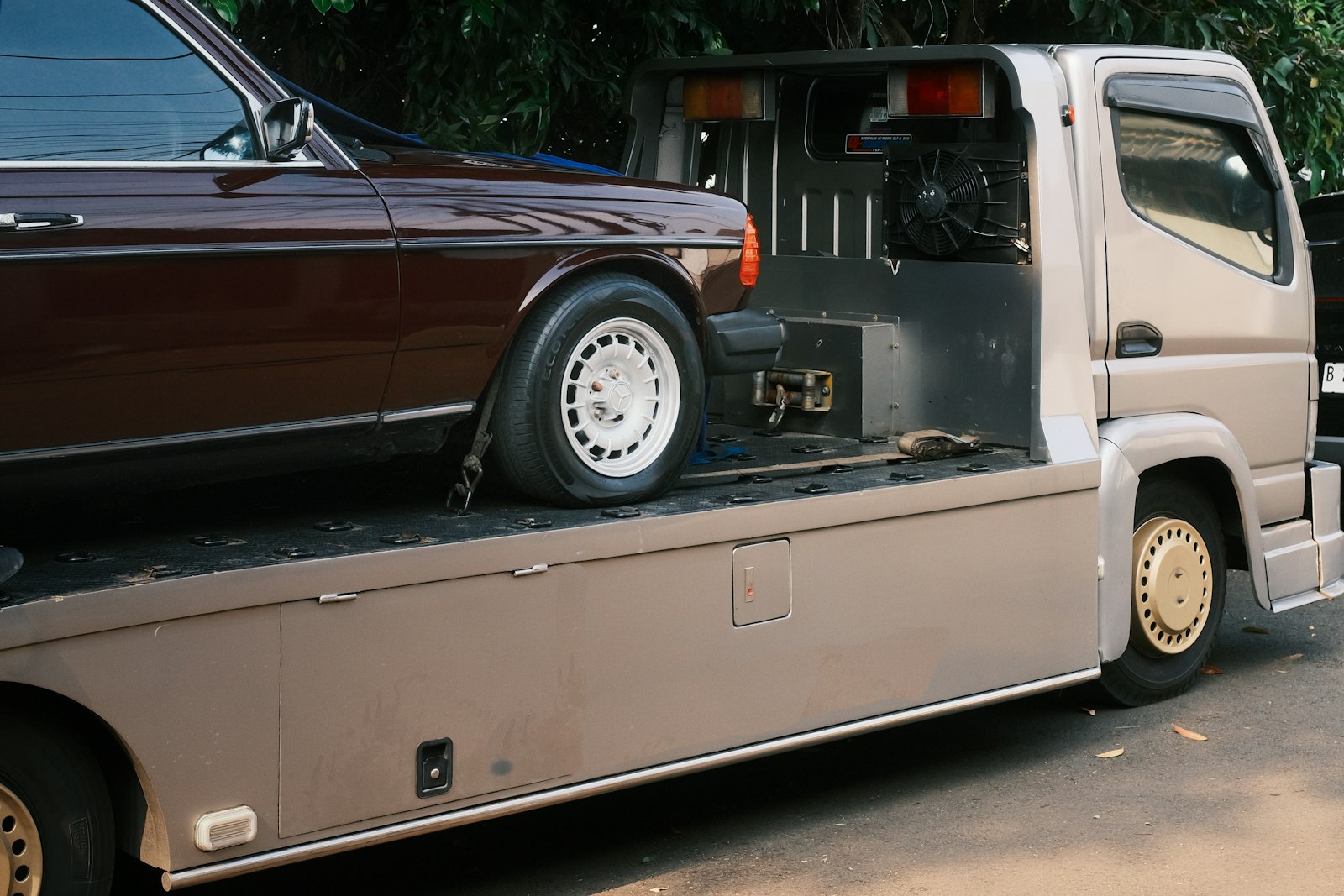
A flatbed is the most straightforward way to satisfy the rule, but it is not the only approved one. Hyundai's towing section spells the alternative out: AWD vehicles must be towed with a wheel lift and dollies or flatbed with all the wheels off the ground. Those are three pieces of equipment doing one job. A wheel lift slides a yoke under one pair of tires and raises that axle clear. Dollies are low wheeled platforms that go under the remaining pair, so the dolly wheels turn and the car's do not. A flatbed takes the whole vehicle onto its deck, which is why it needs the most room: space behind the car to tilt the bed and a reasonably straight line to pull it up. Mazda shows the dolly arrangement for one awkward case, when the parking brake cannot be released. A fourth method is ruled out entirely. Hyundai instructs owners not to tow with sling-type equipment and to use only a wheel lift or flatbed, and Toyota says not to tow with a sling-type truck to prevent body damage.
Neutral Is Not a Workaround
Putting an all-wheel-drive car in neutral protects the transmission; it does not disconnect the drivetrain. The clearest evidence is that one manual asks for both things. Hyundai tells owners to always shift the gear to N before towing in order to prevent damage to the transmission, and on the same page tells them an AWD vehicle still has to have all of its wheels off the ground. If neutral solved the problem, the second instruction would not need to exist. Neutral opens the connection between the engine and the transmission's output. It does nothing to the connection between a turning wheel and the centre differential several feet away. Two details ride along with this one. Toyota notes that the steering lock is not strong enough to hold the front wheels straight when a vehicle is towed from the rear with the engine switch off. And a parking brake that will not release, the case behind Mazda's dolly illustration, changes the equipment list before anyone reaches the drivetrain question.
Read Your Own Manual, Because the Details Differ
The principle is shared across brands; the specifics are not, and the specifics are where a tow goes wrong. Toyota's towing section tells owners to be sure to transport the vehicle with all four wheels raised off the ground, warns that with the tires touching the ground the vehicle may fly off the truck, and specifies tire strapping belts for a flat-bed truck. Kia adds a directional instruction that is easy to miss, saying not to tow the vehicle forwards with the rear wheels on the ground. Mazda's page covers the stuck parking brake. None of those three sentences appears in all three manuals. So find the section before you need it rather than during. It usually sits in the emergency or roadside chapter under a heading like Towing Service or Emergency Towing, and most manufacturers publish the current manual free on their own site, which means it opens on a phone at the roadside. Read the tie-down points while you are there, because where the straps go is the difference between a clean trip and marks on a suspension arm.
Where This Comes Up Around DeLand
The drivetrain question tends to arrive somewhere inconvenient, and in DeLand the inconvenient places are specific. State Road 44 runs through town as New York Avenue and crosses US 17-92, which locals know as Woodland Boulevard, in the downtown grid of the Volusia County seat. Those blocks are tight, with angled parking and short curb cuts, and a car carrier needs clear space behind the vehicle to tilt its deck. A wheel lift with dollies sometimes fits where a flatbed carrier cannot, which is a real reason the method can change on arrival without the rule changing. Head west on SR 44 and the pavement stops being the problem and the ground starts. Volusia County's Ed Stone Park boat ramp sits at 2990 W. State Road 44, and Hontoon Island State Park lies about six miles west of DeLand on the St. Johns River, reachable only by the park ferry or a private boat, so every visiting vehicle waits on the mainland. An AWD crossover that loses its footing near a ramp needs a winch-out before it needs transport, and the same rule binds the moment it is free.
Let the Drivetrain Decide, Not the Clock
The most useful thing you can do is say the words all-wheel drive when you call, before anything is dispatched. It changes the equipment and sometimes the arrival time, and learning that after a truck shows up is how people accept the wrong one. If you are unsure what your badge means, the manual's towing pages say so outright. Hold the rule in the right place: it is not that the vehicle must ride on a flatbed, it is that no wheel may roll. What fails it is a quicker hookup that leaves two tires rolling, trading a tow bill for a drivetrain bill. When the ground under the car is sand instead of pavement, that is a winch-out and off-road recovery job first and a transport job second. On pavement, flatbed towing from DeLand Towing Service is the uncomplicated way to get all four wheels clear.
If a wheel-lift truck arrives without dollies, ask how your car will ride before it is hooked, not after.
Not sure your car can ride on two wheels?
Tell a DeLand dispatcher the make, model and whether it is all-wheel drive, and the right equipment gets loaded before the truck leaves.
All Four Wheels Need to Come Up?
Give us the drivetrain and the location, and a DeLand driver will arrive with a flatbed or a wheel lift and dollies, whichever the spot allows.
(386) 845-3790 Call (386) 845-3790